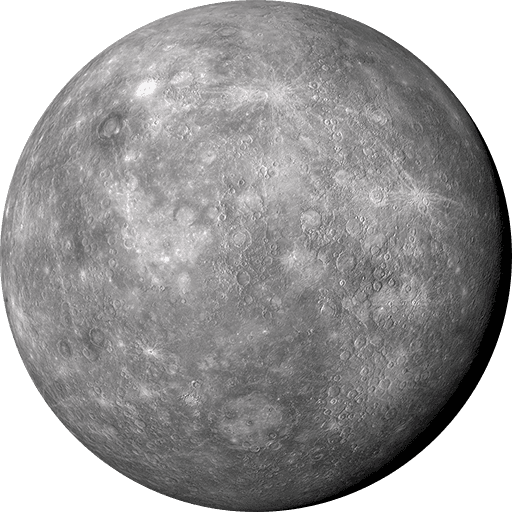
Mercury
Scorching days, frozen nights
Milky Way, 1st planet from the Sun. Sunlight takes 3.2 minutes to get here.
Distant Sun
High 536°Low -277°
7-day forecast
Warming this week
- TodayDistant Sun-277°536°-277°
- FriBright Sun-281°541°-281°
- SatBright Sun-280°543°-280°
- SunBright Sun-285°545°-285°
- MonBright Sun-281°553°-281°
- TueBright Sun-283°550°-283°
- WedBright Sun-281°567°-281°
Temperature through the Mercury year
One full trip around the Sun. The marker shows where Mercury is today.
Orbital position — 0° = perihelion (closest to Sun) · 180° = aphelion (farthest)
Why Mercury's weather works like this
Mercury is the closest planet to the Sun but — counterintuitively — not the hottest. That title goes to Venus, whose thick greenhouse atmosphere traps far more heat. What Mercury does have is the most extreme temperature range of any planet: from around 700 K (800°F) at the subsolar point during closest approach, down to just 100 K (−280°F) on its perpetual dark side.
This extreme swing exists because Mercury has essentially no atmosphere. Its tenuous "exosphere" — sodium, oxygen, and hydrogen atoms briefly lofted from the surface — has less than a trillionth of Earth's surface pressure. With no insulating blanket of air, the surface gains and loses heat purely by radiation.
Mercury's 3:2 spin–orbit resonance creates an unusual relationship between its day and year. It rotates three times on its axis for every two orbits around the Sun, making a single sunrise-to-sunrise cycle last 176 Earth days — exactly two Mercury years. This means some longitudes face the Sun at perihelion (the "hot poles," reaching ~700 K) while others face it at aphelion (the "warm poles," reaching ~570 K).
With essentially zero axial tilt (0.034°), Mercury has no seasons whatsoever. Temperature variation comes entirely from its highly eccentric orbit — at perihelion it receives 2.3 times more solar energy than at aphelion. The permanently shadowed floors of polar craters never see sunlight and maintain temperatures around 90 K, cold enough to harbor stable water ice deposits confirmed by MESSENGER radar.
Where the numbers come from
- NASA NSSDCA Mercury Fact Sheet — Orbital parameters (period 87.969 d, eccentricity 0.2056, obliquity 0.034°, semi-major axis 0.387 AU), black-body temperature (440 K), rotation period (1407.6 h), solar day (4222.6 h), exosphere composition
- NASA Science — Mercury: Facts — Surface temperature range (100–700 K), day/night temperature descriptions, 3:2 spin–orbit resonance explanation, solar day = 176 Earth days
- Bauch et al. 2021 — Estimation of Surface Temperatures on Mercury in Preparation of the MERTIS Experiment onboard BepiColombo (Icarus) — Thermal model surface temperature maps: equatorial max 700 K (hot longitudes) and 570 K (warm longitudes), nightside <100 K, latitude-dependent noon temperatures (645 K at 45°N hot longitudes)
- Valentín Martínez et al. 2023 — How Does the Thermal Environment Affect the Exosphere/Surface Interface at Mercury? (Planetary Science Journal) — Subsolar temperature variation 706 K (perihelion) to 573 K (aphelion), solar flux factor of ~2 between perihelion and aphelion, hot vs warm longitude definitions
- ESA — Meet Mercury (BepiColombo mission page) — Surface temperature range confirmation (−180°C to +450°C), 3:2 resonance rotation-orbit relationship, obliquity ~0.01°
- Space & Telescope — Perihelion of Mercury dates — Mercury perihelion passage dates: December 6, 2024 at 14:00 UTC (reference epoch), perihelion distance 0.30761 AU
How we built the estimate
- Temperatures represent globally-averaged estimates blending dayside and nightside. Actual surface temperatures range from ~100 K (nightside) to ~700 K (subsolar point at perihelion).
- The global mean is derived from the equilibrium black-body temperature (~440 K at the mean orbital distance) scaled by the inverse-square law at each orbital position.
- High temperature represents the peak subsolar surface temperature at the current orbital distance, from thermal models validated by Mariner 10 and MESSENGER observations.
- Low temperature represents the nightside surface, which cools to ~100 K regardless of orbital position due to the lack of atmospheric heat transport.
- Mercury's 3:2 spin–orbit resonance creates 'hot' longitudes (0°W, 180°W) reaching ~700 K and 'warm' longitudes (90°W, 270°W) reaching ~570 K. Our model averages over these.
- The exosphere (surface pressure <0.5 nPa) has negligible thermal effect and is not modeled as an atmosphere.
- Perihelion distance: 0.307 AU (46.0 million km). Aphelion distance: 0.467 AU (69.8 million km). Solar flux varies by factor ~2.3.
- Reference epoch: December 6, 2024, 14:00 UTC perihelion passage, from published ephemeris data.
- MESSENGER mission (2011–2015) confirmed the thermal model predictions and mapped surface temperatures, validating the Bauch et al. (2021) thermal model used as a reference.