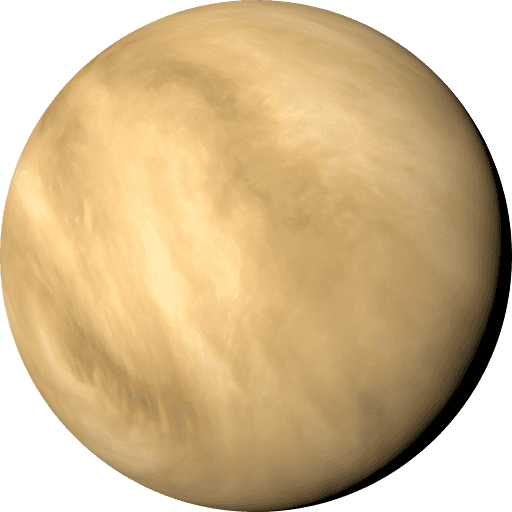
Venus
Perpetual furnace beneath acid clouds
Milky Way, 2nd planet from the Sun. Sunlight takes 6.0 minutes to get here.
Sulfuric Acid Clouds
High 869°Low 857°
7-day forecast
Holding steady this week
- TodaySulfuric Acid Clouds857°869°857°
- FriSulfuric Acid Clouds858°871°858°
- SatSulfuric Acid Clouds860°872°860°
- SunSulfuric Acid Clouds858°870°858°
- MonSulfuric Acid Clouds858°870°858°
- TueSulfuric Acid Clouds858°870°858°
- WedSulfuric Acid Clouds858°869°858°
Temperature through the Venus year
One full trip around the Sun. The marker shows where Venus is today.
Orbital position — Venus's temperature barely varies; the greenhouse effect dominates completely
Why Venus's weather works like this
Venus is the hottest planet in our solar system — hotter than Mercury, despite being nearly twice as far from the Sun. The culprit is a runaway greenhouse effect of staggering proportions: a carbon dioxide atmosphere 92 times the pressure of Earth's traps so much heat that the surface glows a dull red in infrared.
At 737 K (864°F / 462°C), Venus's surface is hot enough to melt lead, tin, and zinc. Soviet Venera landers — the only spacecraft to photograph the surface — survived between 23 minutes and 2 hours before being destroyed by the heat and pressure. Their images show a barren, orange-tinted rocky landscape under a dim, sulfur-yellow sky.
Perhaps the most striking aspect of Venus's climate is its uniformity. The massive atmospheric thermal inertia means there is essentially zero temperature difference between day and night — less than 1 K. There are no seasons (axial tilt is only 2.6°). Latitude barely matters. The whole planet is locked at roughly the same hellish temperature, everywhere, all the time.
Above the surface, dense clouds of sulfuric acid droplets blanket the planet from about 45 to 70 km altitude, making Venus perpetually overcast. These clouds reflect so much sunlight that only about 2.5% reaches the surface — yet the greenhouse effect is so powerful that even this trickle keeps the planet hotter than Mercury at perihelion. The cloud tops host a mysterious "super-rotation": winds of ~100 m/s circle the planet in just 4 Earth days, despite Venus itself taking 243 Earth days to rotate once — and it rotates backwards (retrograde), so the Sun rises in the west.
Where the numbers come from
- NASA NSSDCA Venus Fact Sheet — Orbital parameters (period 224.701 d, eccentricity 0.0068, obliquity 177.36°), surface temperature (737 K), surface pressure (92 bar), atmospheric composition (96.5% CO₂, 3.5% N₂), wind speeds, diurnal range ~0
- NASA Science — Venus: Facts — Surface temperature confirmation (867°F / 462°C), pressure comparison (93× Earth), Venera lander survival times, cloud composition, retrograde rotation description
- Seiff et al. 1985 — Models of the Structure of the Atmosphere of Venus from the Surface to 100 km Altitude (Advances in Space Research) — VIRA reference atmosphere: 735.3 K at 92.1 bar at mean radius, adiabatic lapse rate 8.06 K/km, Pioneer Venus probe temperature profiles, day-night contrast <1 K, latitudinal contrast <5 K below clouds
- Revercomb et al. 1985 — Temperature Structure in the Lower Atmosphere of Venus: Pioneer Venus Entry Probe Measurements (Icarus) — Day-night thermal contrast 3–5 K near cloud base, <1 K below 35 km, temperature profiles from Net Flux Radiometer engineering data, agreement within 2 K with Seiff et al. probe measurements
- Haus et al. 2014 — Venus Nightside Surface Temperature (Scientific Reports / Akatsuki) — Akatsuki infrared nightside map: average surface temperature ~698 K (altitude-dependent), spatial variation dominated by topography (~8 K/km lapse rate), solar heating contributes only ~1–2 K day-night difference
- In-The-Sky.org — Venus at perihelion (DE440 ephemeris) — Venus perihelion passage: February 19, 2025, distance 0.7185 AU, orbit eccentricity confirmation (~1.5% distance variation)
How we built the estimate
- Surface temperature of 737 K (464°C) is from the Venus International Reference Atmosphere (VIRA) standard: 735.3 K at 92.1 bar at the mean planetary radius (Seiff et al. 1985).
- Diurnal temperature variation at the surface is essentially zero (<1 K), confirmed by Pioneer Venus and Venera descent probe measurements at various local times.
- Latitudinal temperature variation is <5 K in the lower atmosphere, per Pioneer Venus probe comparisons (Seiff et al. 1985).
- The 'high' and 'low' temperatures represent the small spatial variation due to topography and latitude, not a day-night cycle. Higher elevations are cooler due to the adiabatic lapse rate (~8 K/km).
- Atmospheric pressure is 92 bar (9.2 MPa) — equivalent to being ~900 meters underwater on Earth. The CO₂ at these conditions is a supercritical fluid with 6.5% the density of water.
- Surface winds are very gentle (0.3–1 m/s), but cloud-top winds reach ~100 m/s in a 'super-rotation' that circles Venus in ~4 Earth days.
- Venus's orbit is the most circular of any planet (eccentricity 0.0068), so solar flux varies by only ~1.4% between perihelion and aphelion — negligible for surface temperature.
- Venus rotates retrograde with a period of 243 Earth days. A solar day (sunrise to sunrise) lasts 116.75 Earth days, shorter than the rotation period due to the combination of retrograde spin and prograde orbit.
- Reference epoch: February 19, 2025 perihelion passage at 0.7185 AU, from JPL DE440 ephemeris.