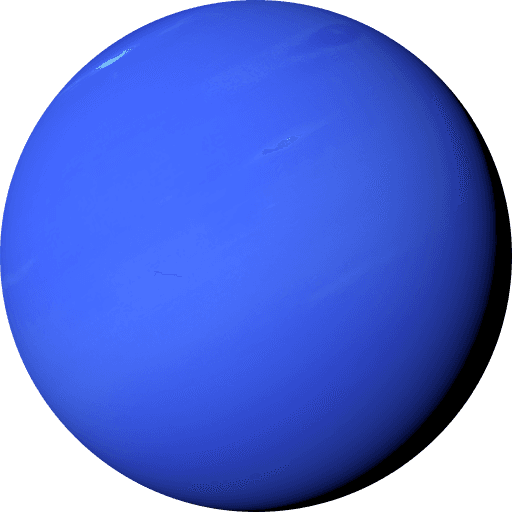
Neptune
The windiest world in the solar system
Milky Way, 8th planet from the Sun. Sunlight takes 4 hours 10 minutes to get here.
Methane Clouds
High -321°Low -336°
Neptune has no solid ground. These readings are for the cloud layer where air pressure matches sea level on Earth.
7-day forecast
Holding steady this week
- TodayMethane Clouds-336°-321°-336°
- FriMethane Clouds-336°-321°-336°
- SatMethane Clouds-336°-321°-336°
- SunMethane Clouds-336°-321°-336°
- MonMethane Clouds-336°-321°-336°
- TueMethane Clouds-336°-321°-336°
- WedMethane Clouds-336°-321°-336°
Temperature through the Neptune year
One full trip around the Sun. The marker shows where Neptune is today.
Orbital position — 0° = reference equinox · 90° = summer solstice · 180° = autumn equinox · 270° = winter solstice
Why Neptune's weather works like this
Neptune is the windiest world in our solar system — and it's not even close. Wind speeds reach 580 m/s (2,100 km/h / 1,300 mph), exceeding the speed of sound. These supersonic gales whip frozen methane clouds across a deep blue atmosphere at the edge of the solar system, 30 times farther from the Sun than Earth.
At the 1-bar level, the temperature is just 72 K (−201°C / −330°F). Yet Neptune radiates 2.61 times more energy than it receives from the Sun — an even larger ratio than Jupiter. What powers this internal heat engine remains one of planetary science's open questions.
Neptune's 28° axial tilt gives it Earth-like seasons, but each one lasts over 40 years. A full Neptunian year takes 165 Earth years — so long that Neptune only completed its first full orbit since discovery in 2011. The planet is currently in its northern late autumn, approaching its next perihelion in 2042.
The atmosphere is strikingly dynamic despite Neptune's frigid remoteness. Voyager 2 photographed the Great Dark Spot in 1989 — a storm system the size of Earth — but it had vanished by the time Hubble looked in 1994. New dark spots have appeared since, proving Neptune's weather is continuously active. The deep blue color comes from methane, which absorbs red light and reflects blue.
Only one spacecraft has ever visited Neptune: Voyager 2, which flew past on August 25, 1989, providing virtually everything we know about this distant ice giant firsthand.
Where the numbers come from
- NASA NSSDCA Neptune Fact Sheet — Orbital parameters (period 60,189 d, eccentricity 0.0097, tilt 28.32°), 1-bar temperature (72 K), atmospheric composition (80% H₂, 19% He, 1.5% CH₄), wind speeds (0–580 m/s)
- NASA Science — Neptune: Facts — Seasonal description (40+ year seasons), wind speeds (>2,000 km/h), Great Dark Spot history, Voyager 2 flyby context, methane color explanation
- Wikipedia — Atmosphere of Neptune — Wind speed profiles (20 m/s eastward to 325 m/s westward), cloud-top temperatures (55 K at 0.1 bar), dynamic storm systems, methane ice clouds, atmospheric structure
- Wikipedia — Neptune (orbital characteristics) — Perihelion dates (1876-Aug-27, next 2042-Sep-04), argument of perihelion 273.187°, internal heat ratio 2.61×, first complete orbit since discovery in 2011
- JPL HORIZONS — Neptune ephemeris — Perihelion confirmation via barycenter orbital elements, orbital period verification
How we built the estimate
- Temperature at the 1-bar level (72 K) is from the Voyager 2 radio occultation measurement. The 0.1-bar level is 55 K.
- Neptune radiates 2.61× more energy than it receives from the Sun. The source of this internal heat is not fully understood — it may involve gravitational settling of heavier elements or residual heat from formation.
- Wind speeds of up to 580 m/s (2,100 km/h) are the fastest of any planet. Most winds are retrograde (westward) relative to the planet's rotation.
- The 'high' and 'low' temperatures reflect estimated spatial variation between equatorial and polar regions at the 1-bar level, based on Voyager 2 and ground-based infrared observations.
- Neptune's 28.32° axial tilt produces real seasons, each lasting ~41 Earth years. However, internal heat dominates the thermal budget, so seasonal temperature variation at 1 bar is very small (~1–2 K).
- The Great Dark Spot observed by Voyager 2 (1989) disappeared by 1994. New dark storms have been observed by Hubble in 2016 and 2018, confirming ongoing dynamic weather activity.
- Atmospheric methane (1.5%) absorbs red wavelengths, giving Neptune its distinctive blue color. Recent reprocessing of Voyager 2 images shows Neptune is less vivid blue than often depicted.
- Neptune's orbit is nearly circular (eccentricity 0.0097). Solar flux varies by less than 2% between perihelion and aphelion.
- Reference epoch: August 27, 1876 perihelion passage. Next perihelion: September 4, 2042. One orbit = ~60,189 Earth days.