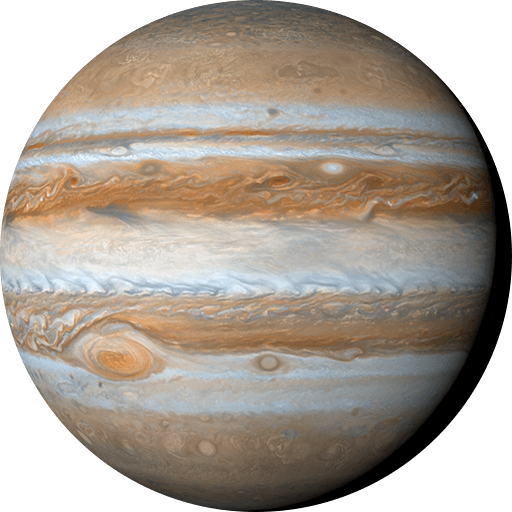
Jupiter
Turbulent bands and endless storms
Milky Way, 5th planet from the Sun. Sunlight takes 43 minutes to get here.
Banded Clouds
High -152°Low -177°
Jupiter has no solid ground. These readings are for the cloud layer where air pressure matches sea level on Earth.
7-day forecast
Holding steady this week
- TodayBanded Clouds-177°-152°-177°
- FriBanded Clouds-177°-152°-177°
- SatBanded Clouds-177°-152°-177°
- SunBanded Clouds-177°-152°-177°
- MonBanded Clouds-177°-152°-177°
- TueBanded Clouds-177°-152°-177°
- WedBanded Clouds-177°-152°-177°
Temperature through the Jupiter year
One full trip around the Sun. The marker shows where Jupiter is today.
Orbital position — 0° = reference equinox · 90° = summer solstice · 180° = autumn equinox · 270° = winter solstice
Why Jupiter's weather works like this
Jupiter is the largest planet in our solar system — so large that all other planets could fit inside it with room to spare. It has no solid surface; what we call its "weather" takes place in an immense atmosphere of hydrogen and helium that gradually transitions from gas to liquid to metallic liquid deep in the interior.
Temperatures are measured at the 1-bar pressure level, the internationally agreed reference altitude for gas giants. The Galileo probe — the only spacecraft to enter Jupiter's atmosphere — measured 166 K (−107°C / −161°F) here in 1995, confirming it from inside. Wind speeds exceeded 600 km/h during descent.
Jupiter's signature look — alternating light zones and dark belts — is driven by powerful zonal jet streams reaching 150 m/s (335 mph) at the equator. These east-west bands host enormous storm systems, including the Great Red Spot, an anticyclonic storm larger than Earth that has persisted for at least 300 years.
Remarkably, Jupiter radiates about 1.67 times more energy than it receives from the Sun, powered by slow gravitational contraction and possibly helium rain in the deep interior. This internal heat source means the temperature is relatively constant regardless of orbital position — Jupiter's weather is driven from below, not above.
The cloud deck has three main layers: ammonia ice crystals on top (the white zones), ammonium hydrosulfide in the middle (contributing to the brown belts), and water ice deep below. Jupiter's 3° axial tilt means seasons are negligible, and its fast 10-hour rotation — the shortest day of any planet — helps drive the powerful jet streams.
Where the numbers come from
- NASA NSSDCA Jupiter Fact Sheet — Orbital parameters (period 4332.6 d, eccentricity 0.0489, tilt 3.13°), 1-bar temperature (165 K), atmospheric composition (89.8% H₂, 10.2% He), wind speeds (up to 150 m/s), cloud aerosol types
- NASA Science — Jupiter: Facts — Three cloud layers (ammonia ice, ammonium hydrosulfide, water ice), Great Red Spot description, banded cloud structure, wind speeds up to 335 mph
- Seiff et al. 1998 — Thermal Structure of Jupiter's Atmosphere Near the Edge of a 5-μm Hot Spot (Journal of Geophysical Research) — Galileo probe temperature at 1 bar: 166.1 ± 0.8 K, temperature-pressure profile from 0.02 to 24 bar, measured at 6.57°N in a 5-μm hot spot
- Gupta et al. 2022 — Jupiter's Temperature Structure: A Reassessment of the Voyager Radio Occultation Measurements (Planetary Science Journal) — Revised Voyager 1-bar temperatures: 170.3 ± 3.8 K at 12°S, 167.3 ± 3.8 K at equator; spatial variation up to ~7 K between 7°N and 12°S
- Fletcher et al. 2016 — Jupiter's Atmospheric Temperatures from Voyager IRIS to Cassini CIRS (Icarus) — Tropospheric seasonal lag ~2.5 years, stratospheric seasonal signal at high latitudes, hemispheric temperature contrasts, radiative time constants
- Antuñano et al. 2021 — Unexpected Long-term Variability in Jupiter's Tropospheric Temperatures (Nature Astronomy) — 40-year tropospheric temperature record, 4/7–9/10–14-year periodicities disconnected from seasons, hemispheric anticorrelations at 16°/22°/30° latitude
- JPL HORIZONS — Jupiter perihelion January 20, 2023 — Perihelion date and distance (4.951 AU), next perihelion December 5, 2034
How we built the estimate
- Temperature at the 1-bar level measured by the Galileo entry probe: 166.1 ± 0.8 K (Seiff et al. 1998). Voyager radio occultation reanalysis suggests 167–170 K at nearby latitudes (Gupta et al. 2022).
- Jupiter's internal heat flux (~5.4 W/m²) exceeds absorbed solar flux (~3.3 W/m²). The planet radiates ~1.67× more energy than it receives. This internal heat dominates the temperature structure.
- The 1-bar 'high' and 'low' temperatures reflect spatial variation between equatorial hot spots (~170 K) and cooler polar regions (~158 K), not diurnal variation (Jupiter's day is only ~10 hours).
- Seasonal temperature variation at the troposphere (250 mbar) is very weak (~1–2 K) and lags solar forcing by ~2.5 years due to high thermal inertia (Fletcher et al. 2016).
- Long-term tropospheric variability includes 4-year, 7–9-year, and 10–14-year cycles that are not simply seasonal, with striking hemispheric anticorrelations (Antuñano et al. 2021).
- Wind speeds from Voyager, Galileo, and Juno: equatorial jet ~150 m/s eastward, multiple alternating jets at other latitudes. Galileo measured >170 m/s below the clouds.
- The Great Red Spot extends ~500 km below the cloud tops (Juno gravity data). Cloud-top wind speeds in the vortex reach ~120 m/s.
- Atmospheric composition at 1 bar: 89.8% H₂, 10.2% He (Galileo HAD), with trace methane (3000 ppm), ammonia (260 ppm), and variable water.
- Reference epoch: January 20, 2023 perihelion at 4.951 AU (JPL HORIZONS). Next perihelion: December 5, 2034.