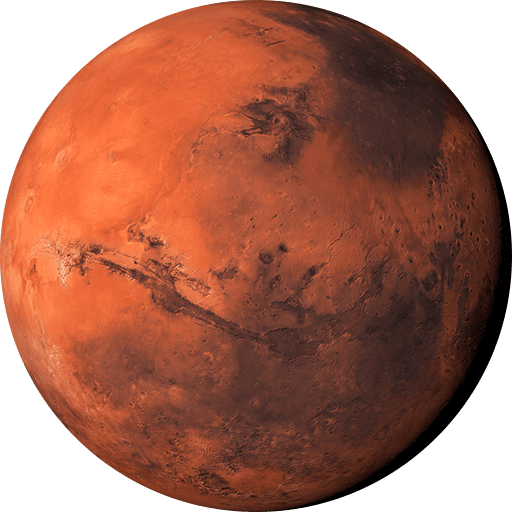
Mars
Cold desert with thin air and dust storms
Milky Way, 4th planet from the Sun. Sunlight takes 13 minutes to get here.
Clear
High -23°Low -138°
7-day forecast
Holding steady this week
- TodayClear-138°-23°-138°
- FriClear-138°-24°-138°
- SatClear-139°-24°-139°
- SunClear-138°-25°-138°
- MonClear-138°-24°-138°
- TueClear-139°-23°-139°
- WedClear-140°-22°-140°
Temperature through the Mars year
One full trip around the Sun. The marker shows where Mars is today.
Solar longitude (Ls) — 0° = N spring equinox · 90° = N summer · 180° = N autumn · 270° = N winter
Why Mars's weather works like this
Mars has the most well-studied climate of any planet besides Earth, thanks to decades of orbiters and surface rovers. Its thin CO₂ atmosphere — less than 1% of Earth's surface pressure — provides almost no insulation, leading to extreme temperature swings between day and night that can exceed 100°F at some locations.
Temperatures vary with season due to Mars's 25° axial tilt, similar to Earth's, and its notably eccentric orbit. Mars receives about 45% more solar energy at its closest approach to the Sun (perihelion) than at its farthest point (aphelion), making this the dominant driver of the global temperature cycle.
Southern hemisphere summer occurs near perihelion, making it warmer but shorter than northern summer. Mars is also prone to regional and occasionally planet-wide dust storms, primarily during southern spring and summer (the "perihelion season"), which can temporarily raise atmospheric temperatures while reducing surface heating.
The atmospheric pressure itself varies by 25–30% through the year as carbon dioxide freezes onto and sublimates from the seasonal polar caps — a process with no parallel on Earth.
Where the numbers come from
- NASA NSSDCA Mars Fact Sheet — Orbital parameters (period, eccentricity, tilt, semi-major axis), mean surface temperature (214 K), diurnal temperature range (184–242 K), surface pressure (636 Pa, range 400–870 Pa), atmospheric composition, wind speeds
- Martinez et al. 2017 — The Modern Near-Surface Martian Climate: A Review of In-situ Meteorological Data from Viking to Curiosity (Space Science Reviews) — Seasonal temperature cycles at Viking and MSL sites, pressure seasonal cycle (CO₂ cap dynamics), wind speed seasonal variation, dust opacity patterns
- Gómez-Elvira et al. — Analysis of the Environmental Conditions at Gale Crater from MSL/REMS Measurements — REMS pressure cycle at Gale (740–925 Pa), ground temperature extremes (173–289 K), pressure minimum Ls ~157° and maximum Ls ~250°
- NASA GISS Mars24 Sunclock — Algorithm and Worked Examples (Allison & McEwen 2000) — Precise Ls calculation algorithm: mean anomaly, equation of center, planetary perturbations, worked verification examples
- Kass et al. 2016 — Interannual Similarity in the Martian Atmosphere During the Dust Storm Season (Geophysical Research Letters) — Regional dust storm classification (A/B/C storms), seasonal Ls timing ranges, temperature signatures at 50 Pa level
- Zurek & Newman 2019 — The Mars Global Dust Storm of 2018 — Global dust storm frequency (~25% per MY), Ls onset clustering, perihelion season definition (Ls 180°–360°)
- LMD — Martian Seasons and Solar Longitude Ls — Ls definitions, Martian month/sol durations, dust season calendar
- The Planetary Society — Mars' Calendar — Mars Year 37–40 season date table, Ls=0° epoch dates for reference
How we built the estimate
- Temperatures represent globally-averaged estimates. Actual conditions vary dramatically with latitude, altitude, local terrain, and time of day.
- The mean global surface temperature of ~214 K (−59°C / −75°F) is well-established from multiple mission datasets.
- Seasonal temperature variation of the global mean is approximately 20 K peak-to-peak, primarily driven by orbital eccentricity (Sun distance).
- The diurnal (day/night) temperature range at the Viking 1 site was 184–242 K (58 K swing). Our model uses a representative ~65 K spread for globally-averaged high/low estimates.
- Atmospheric pressure cycle driven by CO₂ polar cap sublimation/condensation. Minimum at Ls ~150° (CO₂ frozen on south cap), maximum at Ls ~250° (CO₂ released).
- Pressure values normalized to the mean Mars radius reference level (636 Pa mean). Actual measured pressures at MSL's Gale Crater site are higher (740–925 Pa) due to the site's low elevation.
- Wind speeds from Viking Lander sites and MSL/Curiosity REMS. Typical: 2–10 m/s; dust storm: 17–30 m/s; peak gusts: 40–50 m/s.
- Dust storm conditions represent climatological likelihood at each Ls, not specific storm predictions. Global dust storms occur stochastically (~25% probability per Mars year).
- Reference epoch: Mars Year 38 Ls=0° on November 12, 2024, per the Clancy et al. (2000) Mars Year numbering convention.
- Orbital position calculated using the NASA GISS Mars24 algorithm (Allison & McEwen 2000), accurate to ±0.008° Ls.